The deployment of AI as an autonomous reader for chest x-rays has shown promise for helping to improve efficiency. But its trustworthiness currently depends on the specific use case, according to a debate at RSNA 2025.
Autonomous chest x-ray interpretation could become a reality when it achieves zero hallucination, is consistent across all findings, and operates under a clear legal and regulatory framework, said Eun Kyoung (Amy) Hong, MD, PhD, an assistant professor of radiology at Stanford Medicine during the December 4 session.
 "... a pathologist doesn't re-verify the white blood cell count is 7.8 and say it's actually 7.8, thumbs up. No, it's automated," stated chest radiologist Saurabh (Harry) Jha, MD, in the debate.
Autonomous AI yes
"The chest radiograph is not for diagnosis," Jha said. "It's a data point. It's like a pulse oximeter. It's like a white blood cell count. That's all it is. And a data point doesn't need [radiologists] to confirm the data point ... a pathologist doesn't reverify the white blood cell count is 7.8 and say it's actually 7.8, thumbs up. No, it's automated."
Yes, radiologists need to be in the loop, but a human in the loop does not mean in the loop for every single x-ray, Jha added. He proposed that AI for portable chest radiographs should summarize the report into three parts:
- Support lines (where are they or are they unchanged)
- Aeration (better, worsened, or unchanged)
- Is there a pneumothorax?
"That's it. That's all you need," Jha said.
Furthermore, autonomous AI is not going to mean less work for chest radiologists, according to Jha.
"It will mean different work," he said.
Autonomous AI no
On the other hand, Gefter countered with "current AI models are not sufficiently accurate, reliable, or comprehensive enough for totally autonomous chest x-ray interpretation."
 Collaboration between AI and radiologists can be optimized, according to Warren Gefter, MD, former section chief of chest radiology (ret.) from the University of Pennsylvania.
AI/radiologist collaboration is, for now, the better path forward, Gefter said, pointing out major mistakes of AI, such as nonsensical hallucinations (finding left hip prosthesis in situ on chest x-ray), referencing prior imaging findings (when there are no prior studies), and incorrect reference (to the study's applicable modality).
While there has been much recent work on AI-generated draft reports, it's not enough to prove their reliability as a substitute for radiologist-written reports, Gefter added.
"Autonomous AI in particular would require the highest degree of reliable, continuous, real-time drift detection methods and alerts, which, frankly, do not exist currently," he explained. "And of course, there are substantial regulatory hurdles."
Looking at actual real-world performance, "AI does well with so-called narrow or constrained chest x-ray use cases, such as the identification of chest x-rays that are normal or show no actionable disease or for tuberculosis screening in high-burden, under-resourced areas of the world where the benefits clearly outweigh the risks," Gefter continued.
In those scenarios, autonomous AI is currently underway, he added. According to Gefter, collaboration between AI and radiologists can be optimized by having accurate and transparent AI models and by employing valid AI uncertainty quantification metrics so that high-certainty AI findings are read by AI, while low-certainty findings are passed on to the radiologist.
Autonomous AI maybe
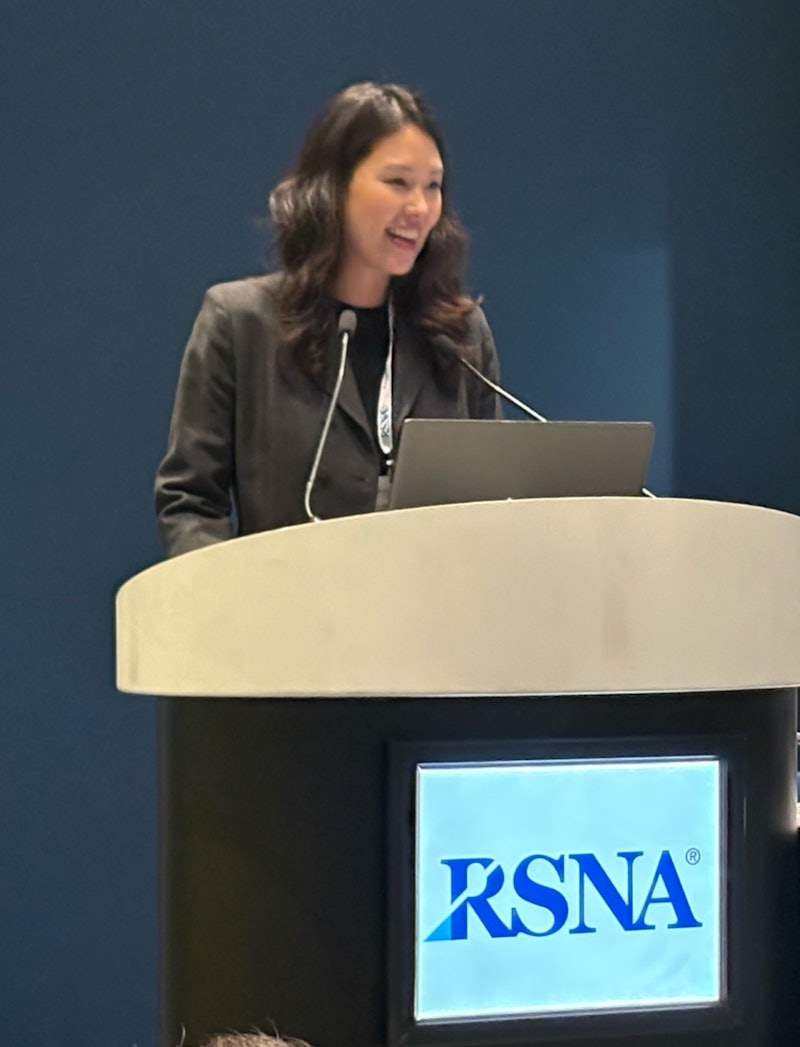 Eun Kyoung (Amy) Hong, MD, PhD, assistant professor of radiology at Stanford Medicine in Palo Alto, CA, said both Jha and Gefter are right in the case they made for and against AI autonomously interpreting chest radiographs.
With a solid vote neither for nor against, Hong highlighted peer-reviewed studies, one showing that AI hallucinations -- unsupported statements -- appear in up to 20% of AI-generated reports. Led by Hong, the study evaluated a domain-specific multimodal generative AI model.
"I define hallucination as mentioning something that was not part of the input to the model," Hong said. "Surprisingly enough, we see a lot of the hallucinations still coming up. But there are ways that we can really reduce the hallucinations in generative AI with fast technical development. I think the problem will be solved very soon."
In addition, recent publications have demonstrated that AI-generated draft reports save radiologists time. One study demonstrated 15% to 20% improved efficiency, and even higher for normal and less complicated cases, Hong noted. The large prospective trial of nearly 12,000 chest x-rays showed that AI reduced interpretation time (from about 189 seconds to 160 seconds) without a significant difference in the quality of the final reports, according to Hong.
"Safety is where the real concern lies," Hong said. "Model variability is substantial. Where different AI systems produce completely different AI-generated reports, which one do we choose? Which one is suitable for our practice? That's a serious issue."
Furthermore, Hong raised concerns about radiologists not trained enough to even have a doubt about the AI output.
Role of radiologists
The debate also clarified how the roles of radiologists will change as AI is implemented into clinical practice.
"Our role would be quality control," Jha said.
AI and humans have very different strengths, added Gefter.
"The idea behind the AI-human collaboration is to leverage these complementary strengths to get the, in fact, to get the best of both worlds," he said. "It also leverages the fact that AI and radiologists make different types of errors so that they can potentially compensate for one another."
In this way, AI and radiologists can partner in these collaborative reporting and workflows, Gefter added.
"And with ongoing advances in multimodal foundation or so-called generalist models and AI agents, AI automation will, in fact, assume an increasing role in this collaboration," he said.
Watchful waiting
Moderator Shah Islam, MD, a consultant interventional neuroradiologist based at the National Hospital for Neurology and Neurosurgery in Queen Square, London, pointed out that the realities of autonomous chest x-ray or chest x-ray AI deployments in the U.K. are defined by setting.
Islam depicted more commercial paid contracts in teleradiology to prevent or minimize reporting discrepancies, and a few paid deployments in the National Health Service (NHS), where there are government and grant-based projects.
"The idea was at the end of it, you'd have an AI-ready NHS for these particular use cases," Islam said. "Everyone's waiting for results of these grant grant-based projects."
Commenters made key points as well, such that the array of support lines and tubes that can be seen on chest x-rays has become enormous. It was noted that for the AI to be trained in the recognition of all these devices, where the proper positions are, what the complications are, and which ones could be fractured, will be an enormous training task.
RSNA's Director of Government Relations Elizabeth (Libby) O'Hare added that policymakers are looking to the radiology community for signals that specific issues have been resolved, which will then inform policies and regulations.
An impromptu poll of the audience suggested that wide-ranging autonomous AI for chest x-ray interpretation could be 20 years away. What say you? Feel free to weigh in using the comments section below.