Most of the attention paid to AI in radiology goes to what happens once an image exists: detection, triage, reporting. In digital radiography, I believe an important area of progress over the next few years will be the extension of intelligent support to earlier stages of the examination, when a radiographer positions the equipment, establishes the required distance, defines the exposure field and, after acquisition, evaluates whether the image is ready to be accepted and sent.
That part of the examination is under pressure. The Am Vincent ChanCarestream Healthcare International
When I wrote for AuntMinnie in 2023, AI support for patient positioning, image quality, and the patient experience was arriving as a set of separate capabilities. In 2026, those capabilities are being designed into a single examination workflow, and that is where I think manufacturers should now be judged.
At the bedside
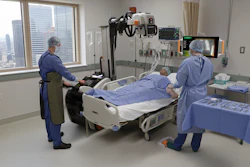
Mobile radiography shows why. At the bedside, a radiographer works around intravenous lines, ventilators, and monitors, often with a patient who cannot be repositioned. Before exposure, they have to place the detector, align the tube, establish the source-to-image distance, and set the collimation, usually without a clear line of sight to all of them at once. Every one of those steps depends on the operator's judgment, and a small error in any of them can mean a compromised image or a repeat exposure.
Our development priorities start from that sequence of tasks. Some setup issues can carry through everything that follows. Image processing, for example, cannot recover anatomy that was excluded from the exposure field. We are therefore extending intelligent support earlier in the workflow, helping radiographers identify potential setup issues while there is still time to make adjustments, and continuing to improve processing consistency after exposure. Both forms of support need to fit naturally into the workflow radiographers already use, because a function that requires a separate screen or an unnecessary additional step is less likely to be used during a busy round.
The DRX-Revolution Prime, the mobile DR system we will introduce at RSNA 2026, is the clearest example of that thinking. It is built on Carestream Intelligence (Ci), our framework for intelligent functions before and after exposure. During setup, a 3D camera provides spatial information on the position of patient and equipment, Auto SID Measurement measures the source-to-image distance automatically, and Virtual Collimation previews the intended exposure field. The radiographer sees what the exposure will cover while there is still time to correct it. Tablet-based operation adds flexibility in how they work around the bed.
After exposure, the central question is the familiar trade-off between dose and noise. Lower exposure produces noisier images, and conventional noise suppression can blur the fine detail a radiologist needs. Smart Noise Cancellation applies deep learning to that problem, separating noise from anatomical detail. In internal reader studies with our cesium iodide detectors, board-certified radiologists compared images acquired at nominal exposure without Smart Noise Cancellation against images at 50% reduced exposure with it, and the results supported equivalent image quality under those study conditions.
Those findings describe the processing technology. They are not a clinical performance claim for the DRX-Revolution Prime as a system. Further downstream, AI can analyze accepted images and flag suspected critical findings to support case prioritization and radiologist review.
Not everything in Ci is AI, and I think manufacturers should say so plainly. Some functions, such as Smart Noise Cancellation, are built on deep learning. Others rely on proprietary algorithms that are not AI at all. Smart Grid applies software-based scatter correction as an alternative to a physical grid in supported applications, and Ci-Fine Rotation corrects image orientation automatically. What matters to the radiographer is whether the task gets easier and the result more consistent. The same approach now extends beyond mobile imaging, to the latest DRX-LC detector for long-length imaging and to the Smart Room capabilities of our DRX-Evolution Plus system.
What should count as progress
I would apply three tests to any intelligent acquisition technology, including our own.
The first is fit. A function has to work inside the examination as radiographers perform it today. If it adds a step, it must give back more than it takes.
The second is consistency. The measure I care about is the variation between operators: how many adjustments are needed before exposure, how often an image is repeated, and whether image quality holds at the exposure actually used. Those can be counted in a department. The number of AI features in a product tells a buyer very little.
The third is validation. Bench tests and reader studies show what a technology is capable of. Only representative clinical use, compared against existing practice, shows what it contributes. Manufacturers should be explicit about which benefits are design intent and which have been demonstrated, and providers should ask.
I expect the next stage of intelligent imaging to be decided by evidence of that kind, gathered at the point of acquisition. At RSNA 2026, we will be showing the DRX-Revolution Prime alongside our other developments in intelligent imaging, and I would particularly like to hear from radiographers about the steps in a bedside examination that still cost them the most time.
Visit Carestream Healthcare International at RSNA 2026, South Hall, Booth 2175, McCormick Place, Chicago.
Vincent Chan is President of Carestream Healthcare International.
References
1. American Society of Radiologic Technologists. 2025 Radiologic Sciences Staffing and Workplace Survey. July 24, 2025.
2. Vincent Chan. 3 AI-based technology trends on display at the 2023 RSNA conference. AuntMinnie, November 22, 2023.
The comments and observations expressed are those of the author and do not necessarily reflect the opinions of AuntMinnie.com.