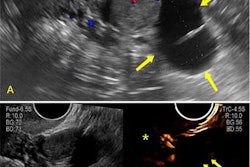
Preoperative ultrasound categorizes most borderline ovarian tumors as intermediate and high-risk (O-RADS 4 and 5), suggest findings presented at ARRS 2026 in Pittsburgh.
In her talk, Erika Baca, MD, from the University of New Mexico in Albuquerque discussed her team’s findings, which suggest that O-RADS appropriately stratifies risk for these adnexal lesions.
“This is clinically important as the treatment for borderline ovarian tumors may or may not spare fertility, and these tend to occur in younger patients,” Baca said.
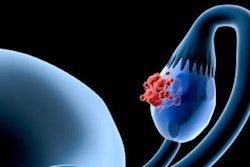
Borderline ovarian tumors are of epithelial origin and come in serous and mucinous subtypes. While the 10-year survival rate exceeds 95%, about one-third of cases occur in women younger than 40. Fertility-preserving treatment may be considered, but if there are no fertility requirements, then total hysterectomy and bilateral salpingo-oophorectomy are recommended.
Baca and colleagues evaluated the distribution and determined risk factors of pathologically-proven borderline ovarian tumors. They used the 2022 version of the O-RADS lexicon to help determine how preoperative ultrasound imaging can best be used for early and accurate diagnosis of these tumors.
The study included 60 women with an age range of 18 to 89 years. The women had an adnexal mass with pathologically confirmed borderline ovarian tumor diagnosis. They underwent pelvic ultrasound between 2020 and 2023 within 12 months prior to the adnexal mass surgery. Independent evaluators assigned O-RADS scores based on ultrasound features collected per the O-RADS lexicon.
All but one case had either a designated O-RADS 4 (n = 36) or 5 (n = 23) category. The one exception had an O-RADS 2 designation. Of the intermediate and high-risk tumors, 42 were serous while 17 were mucinous.
Using univariable and multivariable analyses of ultrasound imaging features, Baca et al reported color score as a strong risk factor. While external contour was a strong but statistically insignificant factor on univariable analysis, it proved to be a weak risk factor on multivariable analysis.
Among other findings, most borderline ovarian tumors showed minimal to moderate flow, had smooth contouring, and were non-solid. In addition, 33 tumors were 10 cm in diameter or greater while 26 were smaller than 10 cm.
With intralesional vascularity being the strongest O-RADS lexicon descriptor and predictor of borderline ovarian tumors, Baca said this can be tricky.
“It can argued as the most subjective [predictor] with how people are grading how much flow is going to the lesion,” she said.
Baca said larger sample sizes could help validate the team’s findings and eventually apply this approach to the MRI O-RADS lexicon.