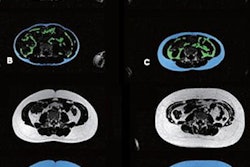

MRI offers an effective way to monitor skeletal muscle adaptations during lifestyle interventions for obesity, such as time-restricted eating and supervised exercise, according to research presented December 4 at the RSNA meeting.
"MRI serves as a powerful tool to accurately monitor skeletal muscle adaptations during lifestyle interventions for obesity," said presenter Rocio Martin Marquez, MD, of Hospital Universitario Reina Sofía in Córdoba, Spain. "Its application enables clinicians to personalize treatment strategies and track therapeutic outcomes more precisely, reinforcing the role of imaging not only in diagnostics but also in optimizing patient management."
MRI offers excellent precision when it comes to evaluating skeletal muscle changes prompted by obesity management strategies, Marquez and colleagues explained, noting that these changes can be complex, as nutritional weight loss interventions can lead to reductions in skeletal muscle tissue, while exercise -- particularly resistance training -- may counteract this effect.
Assessment of the use of MRI to evaluate this kind of skeletal muscle change complexity is limited, so the researchers investigated the effects of a 12-week intervention on 187 obese individuals (average body mass index, 34.8 kg/m²) that combined time-restricted eating and supervised exercise on changes in mid-thigh skeletal muscle tissue using 3-tesla MRI, comparing this protocol to time-restricted eating plus supervised exercise, each of these alone, and "usual care" (defined as open eating and exercise schedules).
The intervention consisted of a Mediterranean diet-based education program; self-selection of an eight-hour eating window for the time-restricted eating and time-restricted eating plus exercise groups; and for the exercise and time-restricted eating plus exercise groups, 24 supervised sessions that combined resistance and high-intensity interval aerobic training, plus a weekly walking program. The team used MRI to quantify mid-thigh skeletal muscle tissue area at baseline and after the intervention.
It reported the following:
- MRI showed significant increases in mid-thigh skeletal muscle tissue area in the exercise group (p < 0.001) and the time-restricted eating plus exercise group (p = 0.04) compared with the usual care group.
- Exercise and time-restricted eating plus exercise groups showed greater skeletal muscle tissue increases compared with the time-restricted eating-only group (both p < 0.001).
Not only did MRI prove effective in providing a useful assessment of the effects of these interventions but it also highlighted which interventions could be most helpful for obese patients.
"Combined time-restricted eating and supervised exercise intervention improved mid-thigh skeletal muscle tissue area in adults with obesity," the group wrote. "These findings suggest that incorporating supervised exercise into time-restricted eating protocols can mitigate potential adverse effects on skeletal muscle tissue, supporting this combined approach as an effective strategy for obesity management."