Smokers with a negative result on baseline low-dose computed tomography (LDCT) lung cancer screening remain at elevated risk of developing the disease -- although that risk does not become statistically significant until at least three years later.
Results from a study conducted by a team led by Yin Liu, PhD, of the Affiliated Cancer Hospital of Zhengzhou University and Henan Cancer Hospital in Zhengzhou, China, could shape how individuals at risk of lung cancer are screened. The study was published March 20 in JAMA Network Open.
"[Our] findings suggest support for extending the initial screening interval and implementing personalized long-term monitoring based on smoking history," Liu and colleagues noted.
Lung cancer is the leading cause of cancer-related death around the world, with an estimated 1.8 million deaths per year, the group explained, noting that in China, an estimated 733,291 lung cancer deaths occurred in 2022 -- accounting for 40.3% of the global total. LDCT improves early detection and thus can reduce mortality among those at high risk of the disease, but about 80% of baseline screens are negative, even among this population, which leaves "a large cohort whose long-term lung cancer risk trajectories remain unclear," the team wrote.
Smoking is the predominant cause of lung cancer, but how it is associated with subsequent lung cancer risk after initial negative LDCT findings isn't clear, according to Liu and colleagues. To address the question, they conducted a study that analyzed outcomes from 30,565 participants with negative baseline low-dose CT findings who participated in China's urban cancer screening program; of these, 14,761 were never smokers and 15,804 were smokers.
The team reported the following:
- Over a median follow-up of 4.4 years, 76 incident lung cancer cases were identified for an incidence rate of approximately 55 per 100,000 person-years.
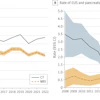
- Smokers faced more than double the lung cancer risk of never-smokers overall (adjusted hazard ratio [AHR], 2.73), with the risk rising among those with 20 or more pack-years of smoking history (AHR, 3.22).
- The elevated risk among smokers was not statistically significant within the first two years following a negative screen. Increased risk emerged at year three and remained stable through year five, a pattern the authors attributed to the biological latency of tobacco-induced lung cancer, in which premalignant lesions likely require several years to become detectable.
The study also found sex-based differences in risk. Women with 30 or more pack-years of smoking history faced dramatically higher hazard ratios than men with comparable exposure (AHR of 5.78 compared to 1.36, respectively). And among never-smokers, 19 of 20 incident lung cancer cases identified occurred in women, nearly all of whom reported high cooking fume exposure -- which underscores the inadequacy of screening criteria focused exclusively on tobacco use, the group noted.
The study is thought-provoking, but further research is needed, wrote Ashley Elizabeth Prosper, MD, and Yannan Lin, MD, PhD, in an accompanying editorial. Both are at the David Geffen School of Medicine at the University of California, Los Angeles.
"Beyond the widely accepted variables of age and smoking exposure, additional risk factors and sex-specific risk are worthy of consideration," Prosper and Lin noted. "Findings from this prospective cohort study should be interpreted with caution and, when possible, should be supported by randomized trial evidence. Acknowledging the limited racial and ethnic diversity of the study cohort presented here, external validation within a more heterogeneous population would increase confidence in the generalizability of this study's findings."
Access the full study here.